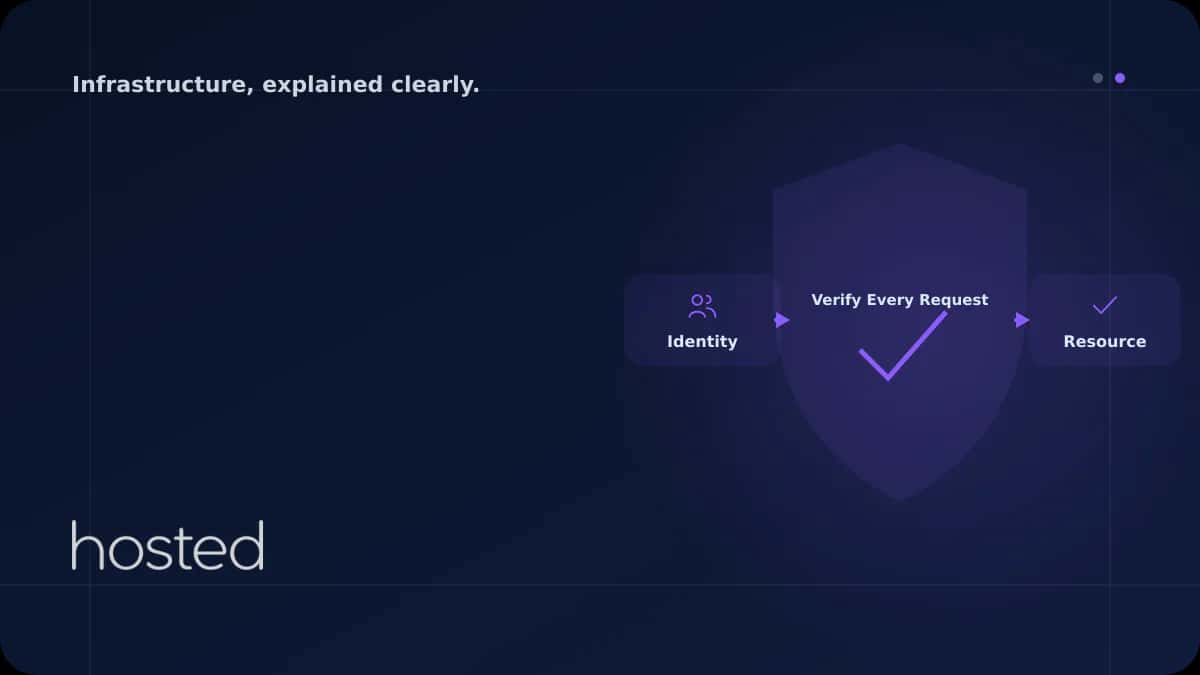
Zero Trust Network Architecture: Implementation Guide for Cloud Environments
Traditional network security relies on the "castle and moat" model: everything outside is a threat, everything inside is trusted. But cloud environments, remote work, and microservice architectures have blurred this boundary. Zero Trust architecture eliminates this assumption: no user, device, or ne
Merve Arslan
WordPress & Hosting Expert
Traditional network security relies on the "castle and moat" model: everything outside is a threat, everything inside is trusted. But cloud environments, remote work, and microservice architectures have blurred this boundary. Zero Trust architecture eliminates this assumption: no user, device, or network segment is trusted by default. Every access request is verified, authorized, and encrypted.
Zero Trust Core Principles
According to the NIST SP 800-207 standard, Zero Trust architecture is built on three core principles. These principles must be applied not only at the network layer but also at the application, data, and identity layers.
-
Never Trust, Always Verify Every access request, including those from within the network, must go through authentication and authorization. Connecting to the internal network via VPN does not grant automatic trust.
-
Least Privilege Principle Every user and service should have only the minimum access required to perform their task. Broad permissions increase the attack surface.
-
Assume Breach Assume your network may already be compromised. Limit lateral movement with micro-segmentation, encrypt all traffic, and perform anomaly detection.
Preventing Lateral Movement with Micro-Segmentation
In traditional flat networks, when one server is compromised, the attacker can access all servers on the same network. Micro-segmentation places each workload within its own security boundary. Communication between services is only possible through explicitly defined policies.
# Kubernetes NetworkPolicy - allow only frontend to backend
apiVersion: networking.k8s.io/v1
kind: NetworkPolicy
metadata:
  name: backend-allow-frontend
  namespace: production
spec:
  podSelector:
    matchLabels:
      app: backend
  policyTypes:
    - Ingress
  ingress:
    - from:
        - podSelector:
            matchLabels:
              app: frontend
      ports:
        - port: 3000
          protocol: TCP
Identity-Based Access Control
In Zero Trust, access decisions are based on identity, not IP addresses. Users, services, and devices are identified with unique identities. Each access request evaluates identity, device posture, location, and risk score.
| Signal | Traditional | Zero Trust |
|---|---|---|
| Authentication | VPN + username/password | MFA + SSO + device certificate |
| Authorization | Based on network segment | Identity + context + risk score |
| Verification Frequency | Once per session | Continuous (every request) |
| Encryption | External traffic only | All traffic (including east-west) |
💡 Tip: Zero Trust migration can be a large project. Instead of trying to transform the entire infrastructure at once, take a phased approach starting with the most critical assets (databases, admin panels). At each phase, analyze existing access logs to remove unnecessary permissions.
For the network layer of Zero Trust architecture, check our VPC isolation guide. For server-level security, see our Server Hardening Checklist. For secrets management, review our Hashicorp Vault guide. Build your secure infrastructure with Hosted Cloud cloud servers.
Frequently Asked Questions
Does Zero Trust replace VPN?
Not exactly, but it changes VPN's role. In Zero Trust, VPN only provides an encrypted tunnel; access decisions are based on identity and context, not VPN connection. ZTNA (Zero Trust Network Access) solutions offer a modern alternative to VPN.
Is Zero Trust necessary for small teams?
Yes, core principles can be applied regardless of scale. MFA enforcement, least privilege principle, and network segmentation can be implemented at low cost even for small teams and significantly improve security.
What is mTLS and why is it important?
mTLS (mutual TLS) is bidirectional TLS where both client and server verify each other with certificates. It prevents identity spoofing in service-to-service communication. Service mesh tools like Istio and Linkerd manage mTLS automatically.
Does Zero Trust affect performance?
Authentication and authorization on every request adds latency (typically 1-5ms). You can minimize this impact with token caching, edge-based policy enforcement, and connection pooling. The security gains far outweigh the performance cost.
How long does a Zero Trust migration take?
A full migration can take 6 months to 2 years depending on infrastructure size. A phased approach is recommended: identity infrastructure first (1-2 months), then micro-segmentation for critical assets (2-3 months), then full coverage.
Conclusion
Zero Trust network architecture provides real security in cloud environments by eliminating the "trusted internal network" assumption. Minimize your attack surface with identity-based access control, micro-segmentation, and continuous verification. Apply Zero Trust principles without disrupting your existing infrastructure using a phased migration strategy.
Secure Cloud Infrastructure
Build your infrastructure with VPC isolation, security groups, and micro-segmentation support on Hosted Cloud.
Explore Secure Server Plans →Merve Arslan
WordPress & Hosting Expert
Creating guide content on WordPress performance optimization, hosting selection, and e-commerce infrastructure.
Comments coming soon